Solid Waste assessment notice: What North Port residents need to know
Published on August 18, 2026
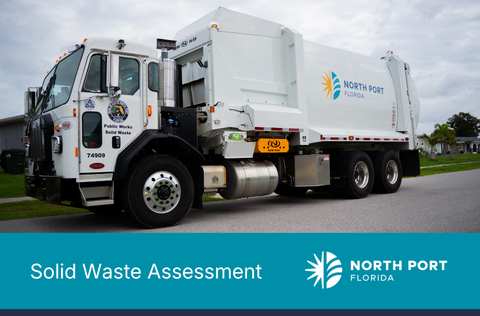
Why did I receive a Solid Waste District assessment notice?
The Solid Waste District assessment funds North Port’s residential garbage, recycling, yard-waste and bulk-waste services. It also supports related equipment and facilities. Unlike a property tax, this is a non-ad valorem assessment based on the benefit provided to residential properties—not the property’s value.
For a developed residential property, the noticed FY 2026-27 amount is:
- Regular annual assessment: $332.75
- Proposed one-time transfer station assessment: $128.01
- Not-to-exceed total: $460.76
Some residents recently received a notice in the mail about the proposed assessment. The increase shown in the notice is NOT proposed as a permanent 38.47% increase in regular collection costs. It consists entirely of a one-time charge to pay for a new Solid Waste Transfer Station in North Port.
This direction was first discussed at a September 2025 City Commission Workshop, where the Commission reached a unanimous decision to proceed with “pay-as-you-go” funding through non-ad valorem assessments. The density-based assessment methodology was chosen at a January 2026 meeting and formally approved at the Solid Waste District meeting in February 2026.
Why did vacant residential parcels receive this notice?
The cost of the new transfer station will be shared among all residential parcels that will benefit from and be able to use the facility, including both currently developed properties and residential parcels that have not yet been developed. The assessment is based on the transfer station's available capacity and the residential properties expected to be served over its useful life. As a result, vacant residential parcels are included because they represent future customers of the Solid Waste District and will benefit from the transfer station's availability when they are developed. Including these properties helps distribute the facility's cost across the full customer base it is designed to serve, rather than placing the entire cost solely on existing residents.
Why aren’t properties north of the Myakka River paying for this transfer station?
Properties north of the Myakka River are not included in the assessment for the proposed transfer station because their solid waste collection vehicles are closer to the landfill and will continue transporting waste directly there. As a result, those properties will not receive the same benefit from the proposed transfer station as properties located in the service area south of the river.
The City has identified the future need for a second transfer station in the Wellen Park area to serve properties north of the Myakka River and already owns property for that purpose. When that facility moves forward, the City anticipates using a similar assessment methodology, with the costs shared among the residential parcels north of the Myakka River that will be served by and benefit from that transfer station.
The notice mentioned an additional 10% increase in future years. What does that mean?
The language verbatim in the notice is: "For fiscal years thereafter, the assessment rate may increase by up to a maximum ofc 10% per year without further notice to pay for increases in the annual cost of providing solid waste management services and allow the District to react to future unforeseen circumstances."
This statement is just explaining that the rate may be increased annually by up to 10% without sending out a notice to each property owner; it is standard language included in the adopted not-to-exceed resolution for Solid Waste.
Any future increases would have to be presented to and approved by the City Commission at a public meeting each budget year.
What is the transfer station for?
The proposed transfer station would allow garbage trucks to temporarily unload trash within North Port to be sorted and prepared. Larger transfer vehicles would then carry consolidated loads to the Sarasota County landfill.
Currently, collection trucks must make lengthy trips directly to the landfill in Nokomis. A local transfer station, planned to be built on Silverleaf Road in the eastern portion of North Port, is expected to:
- Reduce travel time to the landfill;
- Reduce fuel consumption;
- Reduce wear and maintenance on collection trucks; and
- Reduce the number of additional trucks and employees needed as North Port grows.
The City estimates about $13.05 million in operational savings over the first five years of operation once a transfer station opens. Those savings and efficiencies would help keep future increases in customers' Solid Waste fees lower than they otherwise would be.
Why doesn't the City outsource trash and recycling service instead of keeping it in-house?
Maintaining an in-house operation provides the City with greater flexibility and direct oversight to adjust services, address issues, and establish service standards based on the needs of the community. It also allows the City to provide a more responsive and consistent customer experience while maintaining greater control over service costs and operational decisions.
Watch the staff presentation to City Commission from Nov. 23, 2021 for more information.
Didn't voters say no to this in the 2025 Special Election?
Not exactly. The 2025 referendum wasn't a vote on whether to build the transfer station; it was a vote on how to pay for it. Voters were asked whether the Solid Waste District could fund the project through a bond. This would have spread out the cost in small increments paid by current and future Solid Waste customers over 30 years. That measure did not pass.
The City subsequently evaluated other options, including alternative financing and a public-private arrangement. The City Commission selected a pay-as-you-go approach because it avoids interest, financing costs and long-term debt obligations.
Had the referendum passed, the district could have developed the transfer station right away and spread the repayment cost over the life of the bond. This would have avoided a sharp increase in assessment fees, with an estimated impact of about $2 per month per residence.
Since the referendum was unsuccessful, the district couldn't borrow to fund the project and instead had to bank the assessment funds needed for development up front. That's why customer fees are being adjusted by adding a one-time payment to the assessment, rather than spreading the cost over the life of a bond.
So the transfer station itself was never rejected. What voters said no to was the borrowing method, and that choice is why fees look the way they do today, with a bigger upfront cost rather than a small, steady one.